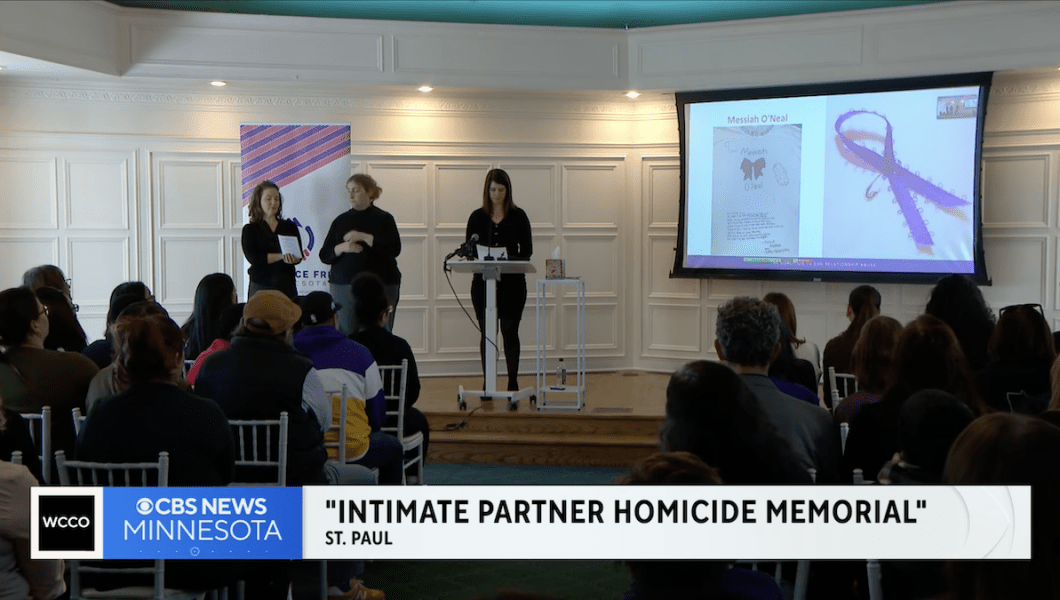
Every year, Violence Free Minnesota reads the names aloud. Thirty-eight names in 2023. Each one a person who woke up on an ordinary morning and did not survive the person who was supposed to love them.
The annual We Remember memorial, held at the St. Paul College Club, is an act of public accounting in a landscape where official accounting is almost entirely absent. State and federal agencies do not systematically collect data on domestic violence homicides or intimate partner homicide. Without organizations like Violence Free Minnesota — a coalition of more than 90 member programs established in 1978 — these deaths would pass without a public record that connects them to each other, to the patterns they represent, and to the systems that failed to prevent them.
For more than three decades, the coalition has published its Homicide Report: Relationship Abuse in Minnesota, documenting each case and making visible what institutional data collection leaves invisible. That work is not advocacy alone. It is the foundational evidence base that makes intervention possible.
Maytong Chang, Advocacy Program Director at Transforming Generations, spoke at this year’s memorial and named what connects every case on this list:
“Domestic violence happens in every community. It also looks different in each community because of cultural practices or beliefs. But, ultimately, domestic violence is about power and control. Killing an intimate partner is the ultimate and final act of power and control.”
That framing matters. Intimate partner homicide is not the explosion of an otherwise stable situation. Research on domestic violence fatality consistently shows that homicide is the endpoint of a pattern — a pattern that, in most cases, was visible before it became lethal. Coercive control, the condition of ongoing subjugation that underlies most intimate partner violence, is present in the majority of domestic homicide cases. The data from Minnesota’s 2023 victims reflects this: coercive control is noted in multiple cases across the list, operating as the context within which the final act of violence occurred.
Nineteen of the 38 people killed were people of color. That number is not incidental. People from minority communities – especially Black women – face compounding vulnerabilities rooted in cultural, social, and structural factors: barriers to accessing services, distrust of law enforcement rooted in legitimate historical experience, language barriers, immigration status concerns, and the specific forms of community pressure that can make disclosure more dangerous rather than less. Closing those gaps requires specialized resources, culturally responsive intervention, and institutional accountability that most jurisdictions have not yet achieved.
The interactive data visualization below draws on the case data for all 38 victims, making visible the patterns of race, gender, manner of death, relationship type, and the presence of coercive control across the full cohort. These are not statistics. They are the coordinates of 38 individual lives, mapped together so that the pattern becomes impossible to look away from.
What the Data Shows
Narcissistic Abuse Rehab · Research
Minnesota 2023 · Intimate Partner Homicide Data
Source: Violence Free Minnesota We Remember Memorial · 38 confirmed named victims
Manner of death
All 38 victims
Race and ethnicity
All 38 victims
Relationship to perpetrator
All 38 victims
Key circumstances
All 38 victims
Data: Violence Free Minnesota Homicide Report 2023. Coercive control noted where explicitly documented in case records.
Global CC Legislation Index →The 38 people remembered at this memorial died across a range of circumstances, but the pattern that connects them is consistent: intimate relationships in which power and control had become lethal.
Firearms were the most common method of killing, appearing across more than half of the cases documented. Several deaths occurred in murder-suicide scenarios — a pattern that research consistently identifies as among the highest-risk presentations in domestic violence, and one that leaves families navigating grief for multiple losses simultaneously.
Coercive control is explicitly noted in multiple cases — not only as the context for homicides committed against a primary partner, but as the operating condition that drew third parties into lethal danger. Antonio Levar Moore was killed defending his sister from her boyfriend’s coercive violence. Justin Capri Boyland and William Lamont Hudson were both killed by their girlfriends’ ex-partners — men who were using the threat of lethal violence as the ultimate expression of control over women who had left. Ricardo Samuel Pena Martinez died in the same pattern. Coercive control does not only kill the person it targets. It kills others in its radius.
Nineteen of the victims were people of color — nearly half of the total. Among the fatalities: six African American victims, four Asian victims (including Hmong and other Asian communities), four Latino victims, one Latina/Native trans woman, and others. The concentration of people of color among domestic violence fatalities is not coincidental. It reflects the intersection of intimate partner violence with structural racism, with barriers to accessing services, with the specific vulnerabilities that immigration status, language access, and distrust of systems create.
Savannah Ryan Williams — a Latina/Native trans woman — represents a population that faces dramatically elevated rates of intimate partner violence and femicide, and dramatically reduced access to appropriate services. Her death, alongside the deaths of others on this list, underscores the imperative of culturally responsive, identity-affirming services for communities at elevated risk.
Two victims — Kyla Bianca O’Neal and her infant son Messiah — were killed together. Kyla was pregnant at the time of her death, placing her within the specific risk category that research consistently identifies as among the most dangerous in intimate partner violence: pregnancy significantly elevates femicide risk, a finding documented across decades of research. Messiah O’Neal, an infant, is a victim of filicide — the killing of a child by a parent or caregiver — in the context of intimate partner homicide.
These are not isolated tragedies. They are the documented endpoints of a system of violence that was present, in most cases, long before it became lethal.
To learn more about the impact of narcissistic rage in extreme cases of abuse, read Mortal Discard: Five Terminal Patterns in Coercive Control.
Why This Data Must Be Collected
Violence Free Minnesota’s documentation work exists because no government agency does it. The federal government does not require states to report intimate partner homicide data in a standardized, disaggregated form. Many jurisdictions do not collect it at all. Without non-governmental organizations doing this work — often with limited resources, and without the institutional authority to compel reporting — the pattern that connects these 39 deaths would remain invisible.
Invisible patterns cannot be interrupted.
The Global Femicide Legislation Index, published by Narcissistic Abuse Rehab in 2026, documents how different jurisdictions around the world address — or fail to address — the legal dimensions of intimate partner femicide. The Global Coercive Control Legislation Index tracks the expansion of coercive control legislation that, in an increasing number of jurisdictions, is beginning to create legal frameworks that can identify dangerous patterns before they become lethal. Both indexes are available at our Coercive Control + Femicide Research hub.
The work of organizations like Violence Free Minnesota, and the research that platforms like Narcissistic Abuse Rehab support, exists in service of the same goal: making the invisible visible, and making what is visible impossible to ignore.
The 2023 Victims – We Remember
- Aldridge, Daniel Joseph
- Bailey Vath, Darisha Tela
- Barham, Logan Gregory
- Bergeson, Danicka Marie
- Bowman, Betty Jo
- Boyland, Justin Capri
- Carda, Sarah Jane
- Corneliusen, Mary A.
- Demarais, Kayla Marie
- Hardy, Don-Shay
- Hudson, William Lamont
- Hulsey, Kayla Rose
- Jansen, Melanie Michele
- Jurado, Manuel Bernal
- Kingsbury, Madeline Jane
- Khang, Youa Vue
- Kline, Jayden Lee
- Mart, Jean Harriette
- Martell, Meredith Marie
- McClelland, Angela Marie
- Medina, Adrian Montano
- Moore, Antonio Levar
- Moore, Kesha Latrice
- O’Brien, Vickie Marie (née Solmonson)
- O’Neal, Kyla Bianca
- O’Neal, Messiah
- Owen, Joshua Anthony
- Parmenter, Hannah Nicole
- Patrick, Sarah Kathryn
- Pena Martinez, Ricardo Samuel
- Schnoor, Sabrina Lee
- Starren, Manijeh “Mani”
- Thomas, Shaqita Monique
- Williams, Savannah Ryan
- Woodhull, Corrina Dawn
- Xayavong, Fanta
- Yang, Jennifer
- Zhang, Jianqin
If You Are in Danger
If you or someone you know is experiencing intimate partner violence or coercive control, confidential support is available.
- National Domestic Violence Hotline (US): 1-800-799-7233
- Crisis text line (US): Text START to 88788
- Violence Free Minnesota: violencefreemn.org
- National Domestic Abuse Helpline (UK) — 0808 2000 247
If you are experiencing coercive control and would like to speak with a specialist, the free 15-minute consultation at Narcissistic Abuse Rehab is available at calendly.com/narcissisticabuserehab/15-minute-consultation.
Related Links
Related Podcast Episodes
Further Reading
References
Manya Wakefield is a narcissistic abuse recovery coach, coercive trauma specialist, and the developer of the Coercive Trauma Recovery Method™ and TENEL™ (Traumatic Exposure to Narcissism in Early Life) — proprietary recovery frameworks built from seven years of direct professional work with survivors of coercive control, narcissistic abuse, and Adult Children of Narcissists. Both frameworks have been reviewed by Dr. Michael Kinsey, PhD, clinical psychologist, New School for Social Research. She is the founder of Narcissistic Abuse Rehab, a global social impact platform launched in 2019 to support survivors through evidence-based recovery frameworks. Manya is the author of Are You In An Emotionally Abusive Relationship (2019), a resource used in domestic violence recovery groups worldwide. Her original research contributions include the Global Coercive Control Legislation Index (2020) — the first systematic index of its kind on the web — and the Global Femicide Legislation Index (2026), comprehensive legal references used by advocates, legal professionals, and policymakers internationally, cited in peer-reviewed publications including the Southern Illinois University Law Journal, Palgrave Macmillan, and the University of Agder. Her expertise has been featured in Newsweek, Elle, Cosmopolitan, HuffPost, Parade, and YourTango. She hosts the Narcissistic Abuse Rehab Podcast, available on Apple Podcasts, Spotify, and Amazon Music. All content on this site reflects Manya's direct professional experience working with survivors of narcissistic abuse and coercive control, her published research, and her ongoing advocacy work.